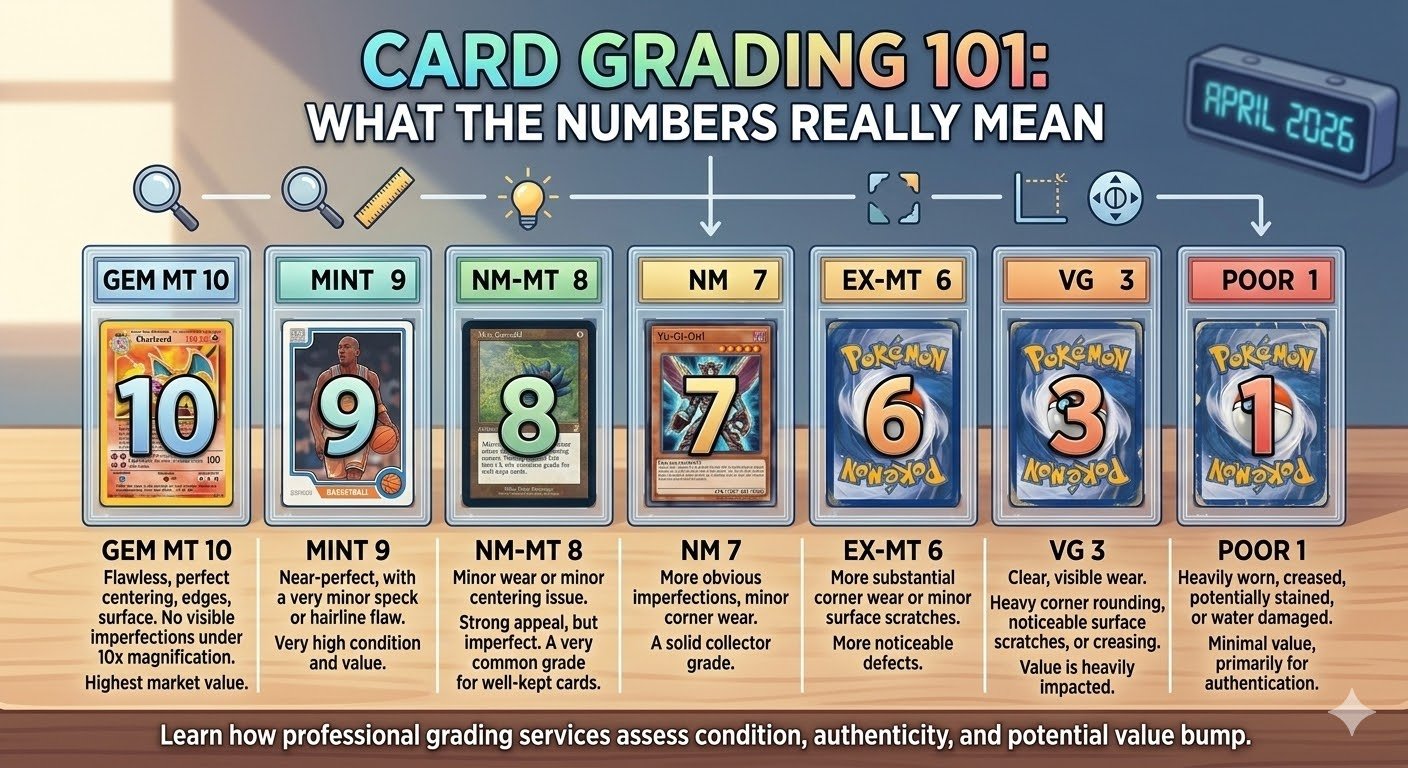
Card Grading 101: What the Numbers Really Mean
You've seen the numbers on slabs — 10, 9, 8 — but what do they actually mean? Understanding the grading scale is essential whether you're buying, selling, or submitting your own cards. Here's the complete breakdown.
The 1–10+ Grading Scale
| Grade | Name | What It Means |
|---|---|---|
| 10+ | Pristine | Virtually flawless. Front centering up to 52/48, back up to 55/45. Razor-sharp corners, no surface flaws under magnification. Exceptional factory quality. |
| 10 | Gem Mint | Outstanding eye appeal. Front up to 55/45, back up to 60/40. Sharp corners and edges with only the most minor, nearly imperceptible imperfections. |
| 9 | Mint | Strong presentation. Front up to 60/40, back up to 65/35. Minor corner, edge, or surface flaws visible only upon close inspection. |
| 8 | Normal-Mint | Clean and attractive. Front up to 65/35, back up to 70/30. Mild corner or edge wear with light surface flaws permitted. |
| 7 | Near-Mint | Well-structured card. Front up to 70/30, back up to 75/25. Noticeable wear on corners and edges. Light scratches possible. |
| 6 | Excellent-Mint | Clear signs of handling. Front up to 75/25, back up to 80/20. Multiple areas of visible wear but structurally sound. |
| 5 | Excellent | Moderate wear. Front up to 80/20, back up to 85/15. Rounded corners, edge chipping, surface scuffing or light creasing. |
| 4 | Very Good–EX | Noticeable wear throughout. Front up to 85/15, back up to 90/10. Pronounced corner rounding, surface wear, minor creases. |
| 3 | Very Good | Significant wear. Front up to 90/10, back up to 95/5. Creases, scratches, and surface degradation present. |
| 2 | Good | Heavy wear. Front greater than 90/10. Creasing, scuffing, or discoloration. Structural integrity maintained. |
| 1 | Poor | Severe damage. Major creases, tears, stains, or paper loss. Centering is not a determining factor at this level. |
The Four Subgrades
Every card is evaluated across four categories that combine to determine the overall grade:
Centering
How well the printed image is positioned within the card's borders. Graders measure the ratio of the left-to-right and top-to-bottom borders on both the front and back. A card with 50/50 centering on all sides is perfectly centered. The tolerances get looser as grades decrease — a Gem Mint 10 allows up to 55/45 on the front, while an Excellent 5 allows up to 80/20.
Corners
Each of the four corners is examined under magnification for sharpness, fraying, rounding, and dings. Even a single soft corner can drop an otherwise perfect card from a 10 to a 9. Corners are often the most scrutinized element of a grade.
Edges
All four edges are inspected for chipping, nicks, rough cuts, whitening (where the card stock shows through), and discoloration. Foil cards and refractors are especially prone to edge issues during manufacturing and handling.
Surface
The card's surface is evaluated for scratches, print lines, ink spots, wax staining, fingerprints, and other blemishes. Surface flaws can be difficult to spot without proper lighting and magnification, which is why professional grading provides value that the naked eye often misses.
Why Does Grading Matter?
Grading removes subjectivity from card condition assessment. When you buy a "near mint" card from a seller, their definition might differ from yours. A professional grade is an objective, third-party assessment that both buyers and sellers can trust. This is why graded cards consistently sell for more than raw cards — the grade eliminates the condition risk for the buyer.
Half Grades
EJE may assign half grades (9.5, 7.5, 6.5, etc.) when a card clearly falls between two grade levels. This gives collectors a more precise assessment and can meaningfully impact value — a 9.5 often sells significantly higher than a 9.
Ready to Get Your Cards Graded?
EJE Cards offers professional authentication and grading starting at just $6.50/card.
Submit Your Cards →